

© 2025
DfN1: Circularity
How Do We Design a System That Takes More Than It Wastes?
The term 'circular economy' was formally introduced by economists Pearce and Turner in their 1990 book, Economics of Natural Resources and Environment.
But the term was developed from the 1970s, with Walter Stahel coining 'closed-loop economy' (a precursor) with Genevieve Reday and Kenneth Boulding discussing 'spaceship earth' in the 1960s.
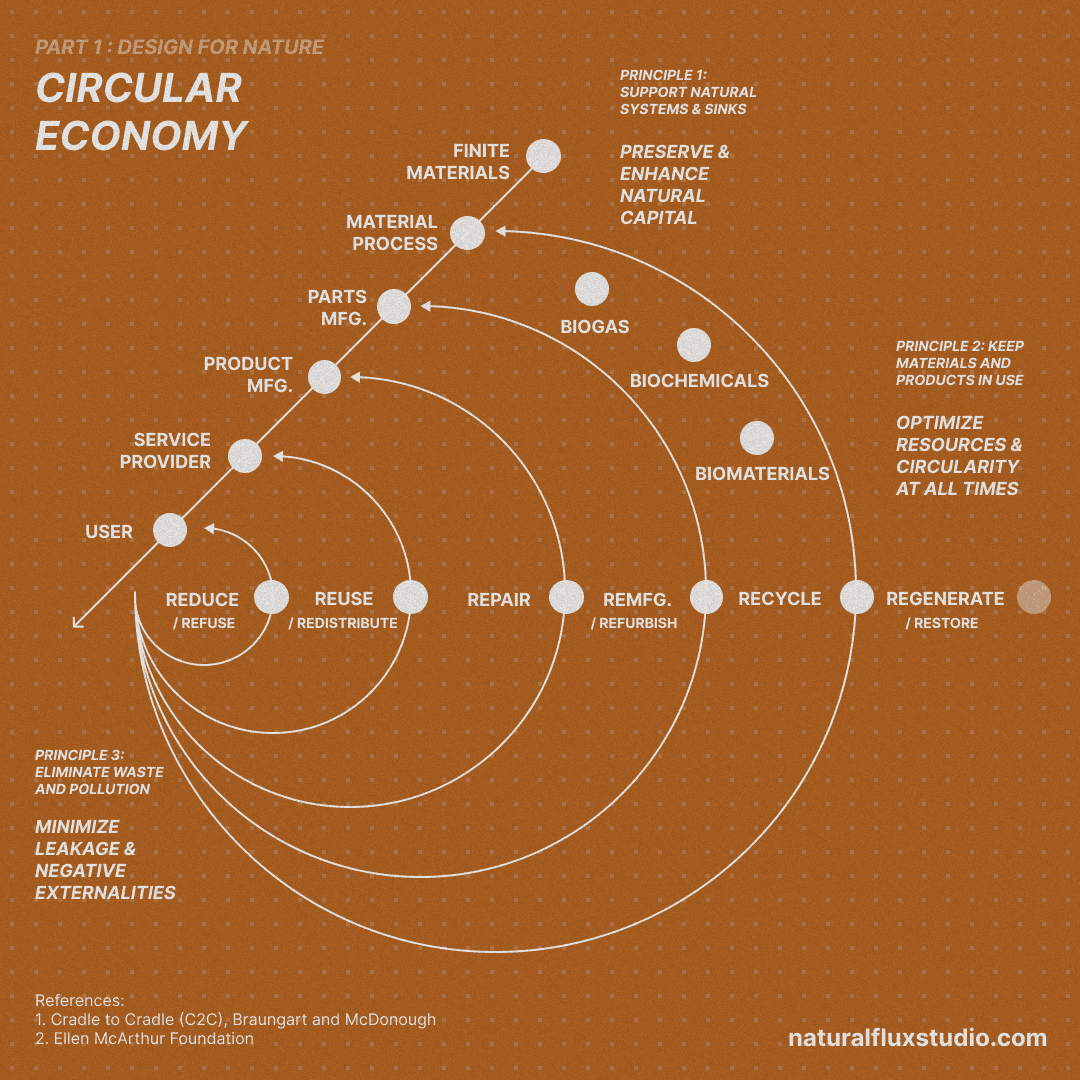
It gained momentum in the 2000s via institutions like the Ellen MacArthur Foundation; McDonough and Braungart expanded it further with the book Cradle to Cradle, and the C2C framework: a design standard where products are made to be safely cycled as nutrients (biological) or technical materials, eliminating waste by design, and mimicking biology.
A few years ago in 2020, I heard a talk by Joe Iles who described present industrial systems as 'circular-ish', a more realistic term when we see how plastics, metals etc, even if repaired and recycled, eventually have an end of life and go to landfill.
The world generates over 2.1 billion tons of municipal waste every year.
That's the problem. Most places in the world, including developed nations, lack sustainable infrastructure for the way we mine, process, consume and discard natural resources / natural capital, in the form of complex products. We need to shift from linear systems to industrial circularity to biological circularity (how nature does not produce any waste).
If you think about it, the underlying ideas of a circular economy: waste less, keep materials in use, and support nature - have been with civilizations for thousands of years, with indigenous communities and many in the global south still following these principles in everyday life.
Although the responsibility should not fall on individuals, we can start by buying less and buying better. Choose raw materials, furniture, textiles, consumables, and other products that are non-toxic, non-exploitative, biodegradable, carbon-neutral, and that have accountable CE and sustainability goals.
Reduce and repurpose the waste generated from food, packaging and industrial processes at hyper-local levels, work with nature, and create your own materials and products at labs, basements and kitchens!
Circular economy models combined with biologically inspired materials can be a promising approach to rethink products, reduce carbon emissions, mitigate global warming and the support the finite resources of Earth.